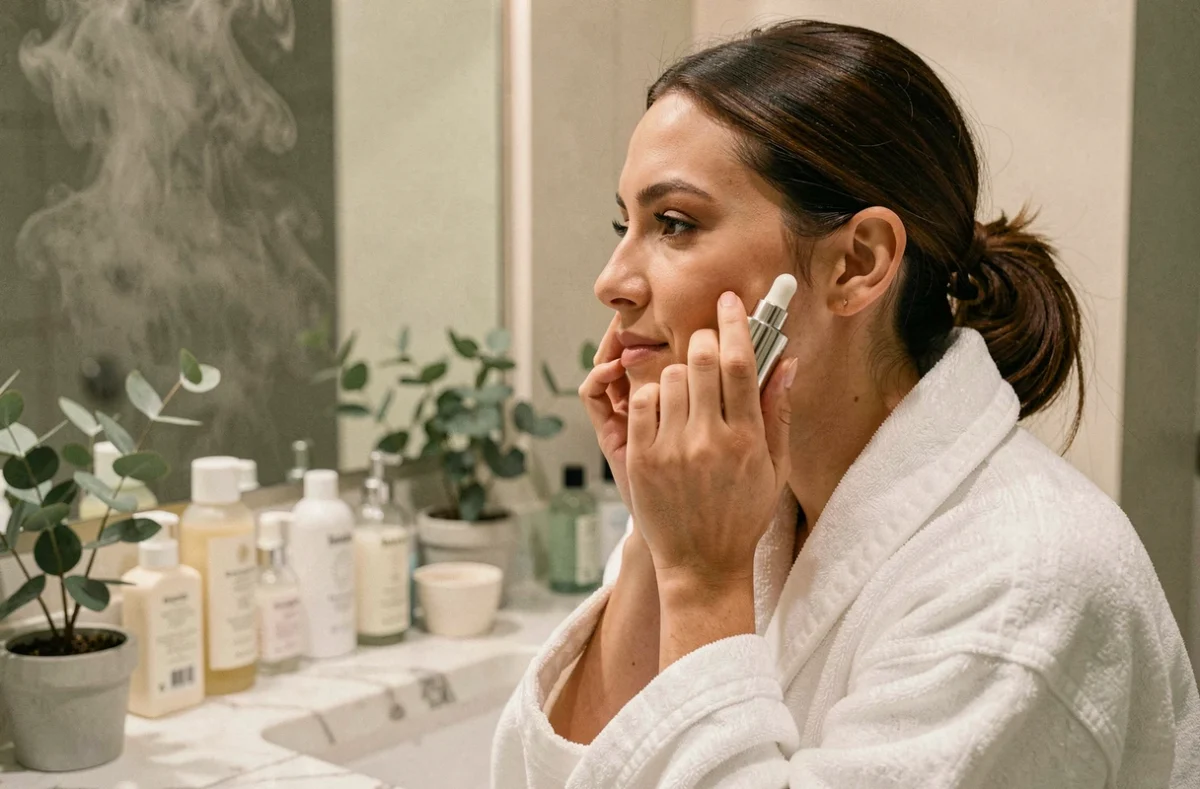
A daily beauty routine is built around a small number of steps with measurable benefits: cleansing, moisturizing and sun protection. The rest, often presented as essential, is more a matter of personal preference than health advice. Distinguishing between the two makes it easier to build an effective routine without adding more products or spending more.
Daily sun protection: the beauty step endorsed by public health authorities
Of all the products presented as essential, sun protection is the only one backed by an international public health recommendation. The WHO advises protection when the UV index reaches 3 or higher—a threshold exceeded for much of the year in southern France and often reached in the north between April and September.
This guideline changes how you think about your routine. Applying sunscreen isn’t just for beach holidays. In urban areas, sunlight reflected off asphalt and glass exposes your face to cumulative UV doses that accelerate skin aging.
An SPF 30 sunscreen, applied in sufficient quantity to the face, is the step with the best-documented cost-benefit ratio in dermatology. A tube costing just a few euros at a pharmacy works just as well as a day cream with SPF that costs three times as much, provided you apply enough. Resources such as https://beautiva.fr make it easier to compare available formulas and find textures suited to each skin type.
Natural and organic cosmetics: what the label really tells you
The word “natural” on a skincare bottle has no single regulatory definition. The DGCCRF notes that claims made about cosmetics must be fair and that “organic” and “natural” claims follow specific standards, such as Cosmos or Ecocert, whose requirements vary.

A product bearing the Cosmos Organic label guarantees a minimum percentage of ingredients from organic sources. A product simply labeled “natural” without third-party certification offers no comparable guarantee. The difference is on the packaging, not in the marketing claims.
When assessing a skincare product, three concrete details are worth checking:
- The INCI list (International Nomenclature of Cosmetic Ingredients), which lists ingredients in descending order of concentration. If the featured active ingredient appears near the end, it is present only in a negligible amount.
- Whether it carries a label certified by an independent organization (Cosmos, Natrue, Ecocert), which requires compliance with verifiable standards.
- Whether the product category supports the claim: a “anti-aging” serum based on floral water does not have the same level of evidence as a product containing a measured dose of retinol.
This simple checklist helps you avoid paying a premium for an ordinary formula dressed up in plant-inspired packaging.
Microplastics in cosmetics: the European regulatory timeline
Regulation (EU) 2023/2055, published on 27 September 2023, gradually restricts the use of certain synthetic polymer microparticles in cosmetics. Rinse-off products (shampoos, shower gels) containing these particles are subject to an October 2027 deadline. Leave-on products (creams, serums) have longer, until October 2029.
This timeline does not mean that all current products will be withdrawn from the market. The scope depends on the exact composition and the exemptions set out in the regulation. Cosmetic glitter, for example, is subject to specific provisions.
For consumers, there are two practical implications. First, formulas will change: brands are already reformulating ahead of the deadlines. Second, checking a product’s ingredients before buying is a useful habit, especially for scrubs and exfoliating products that have traditionally used plastic microbeads.
Environmental claims: how to spot greenwashing in beauty
Directive (EU) 2024/825, published on 6 March 2024, targets generic environmental claims that are not substantiated. It is due to apply from 27 September 2026. Terms such as “green,” “eco-friendly” or “planet-friendly,” when used without evidence or certification, will fall under this directive.
In the beauty industry, greenwashing takes familiar forms:
- Cardboard packaging that conceals a plastic bottle inside, creating the misleading impression that waste has been reduced.
- A “paraben-free” claim promoted as an environmental benefit, even though the absence of parabens says nothing about the product’s overall environmental impact.
- Images of leaves or nature on the label of a product whose formula consists mainly of synthetic ingredients.
A reliable environmental label is based on third-party certification and publicly available standards. A brand’s own claims, however appealing, are not proof.
Affordable beauty routine: the steps that really matter
A useful daily routine doesn’t require more than three or four products. Cleansing (a gentle cleanser suited to your skin type), moisturizing (a cream or lightweight product depending on the season) and sun protection cover the basic needs supported by dermatological research.
Serums, oils, mists and essences are extras, not essentials. Adding a product only makes sense if it addresses a specific skin concern: persistent dryness despite moisturizer, targeted hyperpigmentation or inflammatory acne. Without a diagnosis, layering products increases both your spending and the risk of interactions between active ingredients.
Everyday well-being also comes from consistency rather than complexity. A simple step repeated every day delivers better results than an elaborate routine abandoned after two weeks. Beauty trends change every season, but the skin’s basic physiology remains the same.